
A Secular Vocation
Why Patient Support attracts people drawn to service, and why an industry built on science should defend evidence, uncertainty and expertise.

When you work in Patient Support long enough, you cannot help but notice patterns. One that I have always found quietly moving is the number of people in our field who have backgrounds in theology, divinity, ministry or worship music.
I offer this as an observation rather than an analysis. I have not conducted a survey, and I cannot tell you whether former theology students and church musicians are statistically overrepresented in Patient Support. I can only tell you that I have met enough of them over the years to notice.
At first, I thought it was simply an interesting coincidence. The more I thought about it, though, the more sense it made.
I have written before about how Patient Support can allow people to retain some sense of human decency and stewardship while still earning a comfortable living and supporting a family. We work inside a commercial industry, yes, but the substance of the work is often deeply human.
A person has been diagnosed with a serious illness. A physician has prescribed a treatment. Somewhere between that prescription and the Patient receiving it, a whole series of obstacles appears: insurance rules, prior authorizations, financial hardship, infusion logistics, transportation, fear, confusion and the overwhelming administrative burden of being sick in America.
Our job is to help, and perhaps Patient Support has become a kind of secular vocation.
By “secular,” I mean work conducted outside a formal religious institution that still offers an opportunity to practice service, stewardship and care for other human beings. People may leave ministry, or decide against entering it, without leaving behind the part of themselves that was drawn to a life of service. They may simply find another expression of it.
The more I sat with that idea, the more I realized that service is only part of what draws me to this work. On some level, we also participate in science.
I can practically hear my Medical Affairs friends clearing their throats, so allow me to qualify that statement. Our role is different from that of the people designing clinical trials, studying mechanisms of action, responding to medical information requests, discovering molecules or publishing findings.
Discovery, however, is only part of the journey. Science has to reach someone. It has to travel from the laboratory to the clinical trial, through regulatory review, into the healthcare system and, finally, to an actual person whose life might be changed by it.
Patient Support helps carry the science across that last distance. We help make the treatment real for the person who needs it.
Perhaps that is one reason I have always felt so at home in this work. I have spent much of my life hovering around science without ever building a conventional scientific career.
Despite my best efforts, and much to my disappointment, I did not have the temperament or the talent to be a bench scientist. I loved the questions far more than I loved the painstaking repetition required to answer them. I was fascinated by the work, but I was not especially gifted at doing it, so I found other ways to stay close to science.
My love affair with evolution began, appropriately enough, with an actual crush. There was a boy I liked in college who was reading Daniel Dennett’s Darwin’s Dangerous Idea. So, naturally, I read it too. I was hoping to impress the boy.
It turned out I was much more impressed by Dennett. Stephen Jay Gould and Ernst Mayr quickly became my new crushes. Nothing happened with the young man, but my fascination with evolution stuck.
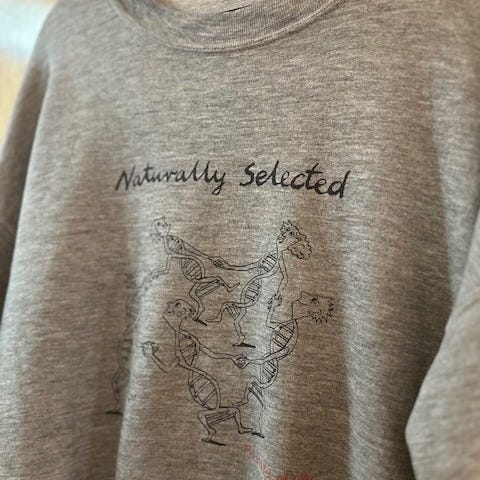
Years later, one of my most prized possessions is a very battered sweatshirt that I have now owned for almost 20 years. Nature ran a little online contest for the best tweet about evolution. I entered and won.
The prize was the sweatshirt, a note of congratulations and a tiny amount of bragging rights that I have clearly managed to stretch across two decades. A few people responded at the time with some version of, “Who is she? She isn’t a scientist.”
I will admit that my feelings were a little hurt.
At the time, I was working in hospital administration in San Francisco. I was single, somewhat miserable and apparently spending my evenings engaged in the famously creepy single-woman activity of scrolling through online science journals.
What the commenters did not know was that I had once worked as a production assistant on a public television series devoted to evolution. Years earlier, I had received a small undergraduate research fellowship and spent a summer counting a great many fruit flies. Later, I taught middle school science and studied epidemiology.
None of those experiences made me a career scientist. They did, however, make science one of the languages through which I understood the world.
Science is just so cool. It gives us a disciplined way to explain the world around us and pursue answers. It requires evidence, makes room for uncertainty and expects conclusions to change when better information becomes available.
That willingness to change is part of the point. Scientific knowledge develops. The available evidence changes. A responsible answer given today may need to be revised tomorrow, and that revision does not automatically prove that the original answer was corrupt, deceptive or foolish. Sometimes it means the process is working.
This week’s Senate hearing involving Anthony Fauci is what set all of this thinking in motion for me.
On Wednesday, July 29, Fauci appeared before the Senate Homeland Security and Governmental Affairs Committee. During a hearing that lasted nearly three hours, he invoked his Fifth Amendment rights more than 100 times rather than answer questions about his role in the COVID-19 pandemic and the debate over its origins.
Fauci should be scrutinized, as should any scientist, institution or public official. People can reasonably disagree about him and about decisions made during the pandemic. Public servants should be subject to oversight, and scientific credentials should never provide immunity from accountability.
Anthony Fauci is responsible for his own decisions. My concern is with the wider disdain that has gathered around anyone associated with the pandemic response.
I found the tenor of the proceeding profoundly dispiriting. The hearing felt punitive and contemptuous. Its energy seemed directed toward producing a villain, with little visible interest in understanding how enormously consequential decisions had been made under conditions of deep uncertainty.
Perhaps some people believe that villain is deserved. Part of my reaction is personal.
My father died at Brigham and Women’s Hospital between Christmas and New Year’s in 2021, during the first enormous surge of the Omicron variant. He was a very old man with multiple cancers and a failing heart and kidneys. Dad had driven himself to the hospital, and up until the day before he passed, he was demanding that I transfer him to Mass General because he wanted third and fourth opinions. We knew he was dying. I had packed clothes for his funeral when I left San Francisco. But I thought we had a month, maybe six weeks. We had only days.
I cannot overstate the chaotic scene at the hospital doors. Members of the National Guard were monitoring the hospital entrance. A strict no-visitors policy was in place, and we needed special permission for me to accompany my mother so that we could sit with my father in the ICU.
It was one of the most heartbreaking chapters of my life, although also, in the deepest sense, a natural one. My father was dying. My mother needed me. We were allowed to be with him.
What I will never forget is the exhaustion of the healthcare workers. They were tired beyond the bone, down to the marrow. Their frustration with the pandemic was palpable, as was their frustration with people who had refused vaccination even after vaccines had been widely available for months.
They cared for everyone anyway. They took extraordinary precautions, assumed risks and made exceptions when humanity required one. They allowed my mother and me into that hospital and helped us through one of the worst moments of our lives.
When I listened to some of the language surrounding the Fauci hearing, I could not separate it from those people. The contempt may have been directed at one man, but it seemed to reach further. It reached the scientists, public-health workers and exhausted clinicians who made decisions with incomplete information, revised those decisions as the evidence changed and continued showing up to care for people anyway.
Fallible human beings doing impossible work should not be swept into the role of enemy.
Investigating mistakes is legitimate; in fact, it is scientific. Treating uncertainty as evidence of deceit, or using individual failures to cultivate contempt for science, does damage that extends well beyond Anthony Fauci.
Contempt teaches people that changing a conclusion is evidence of dishonesty. It converts scientific uncertainty into a character flaw. It makes expertise look like a con practiced by people who believe they are too clever to be questioned.
Watching the hearing and the commentary that followed, I kept wondering why I had heard so little from our own industry.
The pharmaceutical and biotechnology industries depend upon science. We depend upon scientists willing to spend their lives investigating questions that may not produce answers. Our work also relies on public research institutions, clinical trial participants, clinicians, regulators and public servants willing to make extraordinarily consequential decisions with the evidence available to them at the time.
We also depend upon the public continuing to believe that science is worth funding, pursuing and trusting.
Trust makes room for scrutiny, disagreement, uncertainty and error. It can survive scientists being wrong, institutions failing and public officials making poor decisions.
Our industry ought to defend science without pretending that every scientist is right. We can support legitimate oversight and still object when it becomes political theater. We can say plainly that evidence, expertise and scientific institutions remain worth protecting, even when doing so is politically uncomfortable.
I fully appreciate the professional calculation involved in saying any of this publicly. My expertise, my writing and my business occupy a very small and highly specific corner of the internet centered on commercial pharma, Market Access and Patient Support. I like my corner. I am not trying to become a political commentator, and I have no delusions that my thoughts will change the national conversation.
I may be letting my political freak flag fly only a few inches above the ground here, but I am letting it fly. Silence carries its own risk, particularly for those of us for whom science is personal.
Many people enter Patient Support because illness has already entered their homes. We have watched a parent, spouse, child or friend navigate a frightening diagnosis. Some of us have been Patients ourselves.
We are still here to do this work because science reached us, or someone we love.
Somewhere, a researcher asked a question. Someone counted the fruit flies. Someone studied the cells. Someone volunteered for a clinical trial. Someone reviewed the evidence. Someone invested in manufacturing. Someone approved the treatment, and then a long chain of people helped that treatment reach a Patient.
We are part of that chain.
Perhaps that is why Patient Support attracts people who once imagined a life in ministry and people like me who have always been a little bit in love with science. The work allows us to practice stewardship while helping turn discovery into something real.
Patient Support belongs to the long chain that carries science into human lives.
That feels like a vocation to me.
A note on AI use
I wrote this piece. I used AI during the editing process to pressure-test its structure, clarity, accuracy, and brand risk. The voice, opinions, examples, and final editorial calls are mine.
No one is requiring me to disclose this. I believe in being honest about how I use AI. Used well, it helps me sharpen the work; it does not replace the thinking, judgment, or two decades I spent working in hospitals and life sciences.
I felt this to my core. Thanks for saying what others brush under the carpet. Bold. I love it!